Digital retrofit and digitalisation of production tools

Digital retrofit means modernising an existing machine or line (sensors, control, communication, software) without replacing it. It keeps producing as before, but can now exchange data with the rest of your information system.

Assess my machine

What a retrofit can bring

  • Communication with the MES/MOM and ERP: the machine receives its production orders and reports rates and states.
  • Real-time production data: rates, stops, alarms, quality indicators.
  • Feeding the CMMS: running hours, cycles and alarms reported automatically to trigger preventive maintenance at the right time.
  • No more manual entry or paper: fewer errors, easier traceability.
  • Longer equipment life for a mechanically sound machine whose manufacturer no longer offers upgrades: savings and a better HSE record.
  • Upgrading what is there: depending on the machine, safety or ergonomics points can be addressed along the way.

Illustrative case

Paul and his production machine

No communication MES / MOM ?
1. The problem. Paul's machine still produces very well, but its original software cannot talk to the MES/MOM.
Resale ≈ €50k New machine ≈ €300k ≈ €250–300k
2. Option 1: replace. A new machine costs around €300k, hoping to resell the old one for about €50k.
Existing machine ShoWise ≈ €50k MES / MOM
3. Option 2: retrofit. The machine stays in place. A ShoWise gateway connects it to the MES/MOM, for ≈ €50k.
Replace≈ €250–300k ShoWise retrofit≈ €50k
4. The result. The retrofit costs several times less than replacement.
Machine reused No scrapping Better HSE record
5. The HSE bonus. Reusing the equipment avoids building a new machine and scrapping the old one.

Paul runs an industrial SME. His production machine still works very well, but its original software cannot communicate with his MES/MOM.

A new machine performing the same function would cost around €300k. Paul could hope to resell the old one for around €50k on the second-hand market.

As a bonus, reusing the equipment avoids building a new machine and scrapping the old one: this improves Paul's HSE record.

Plan ahead

The end-of-life control PC: act before it fails

On many machines, the control side relies on an ageing PC or operator panel: an old operating system, software whose vendor has disappeared, an interface card that can no longer be bought. The mechanics, meanwhile, are in perfect condition.

As long as everything works, nobody thinks about it. But the day the hard drive fails or the PC breaks down, nobody knows how to reinstall the software, or the non-standard interface no longer exists: the whole machine is scrapped, although it was still producing very well.

The right time to act is now, while the machine is still operational. As part of a preventive audit, ShoWise analyses and documents how the control side really works (reverse engineering), then replaces it with a modern, durable and maintainable solution, without touching the rest of the machine.

The documentation handed over lets anyone other than ShoWise step in again.

Warning signs

  • A PC that will not start from cold on Monday morning (ageing hard drive)
  • A control PC running an abandoned operating system
  • Software with no installer, no vendor, or whose licence nobody holds
  • A proprietary card or interface that cannot be found on the market
  • No backup of the system, or one that has never been tested
  • Only one person knows how to restart the machine

After the failure it is often too late: there is nothing left to observe or copy.

What ShoWise delivers

  • On-site audit of what is in place: machine, PLC, network, constraints
  • Preventive audit of the control side: analysis and documentation before it fails
  • Interface electronics: gateway, sensors, custom boards
  • Communication software towards your systems, using common industrial protocols (OPC UA, Modbus, MQTT, fieldbus)
  • Testing and validation, on a bench before the intervention whenever possible
  • Technical documentation handed over at delivery
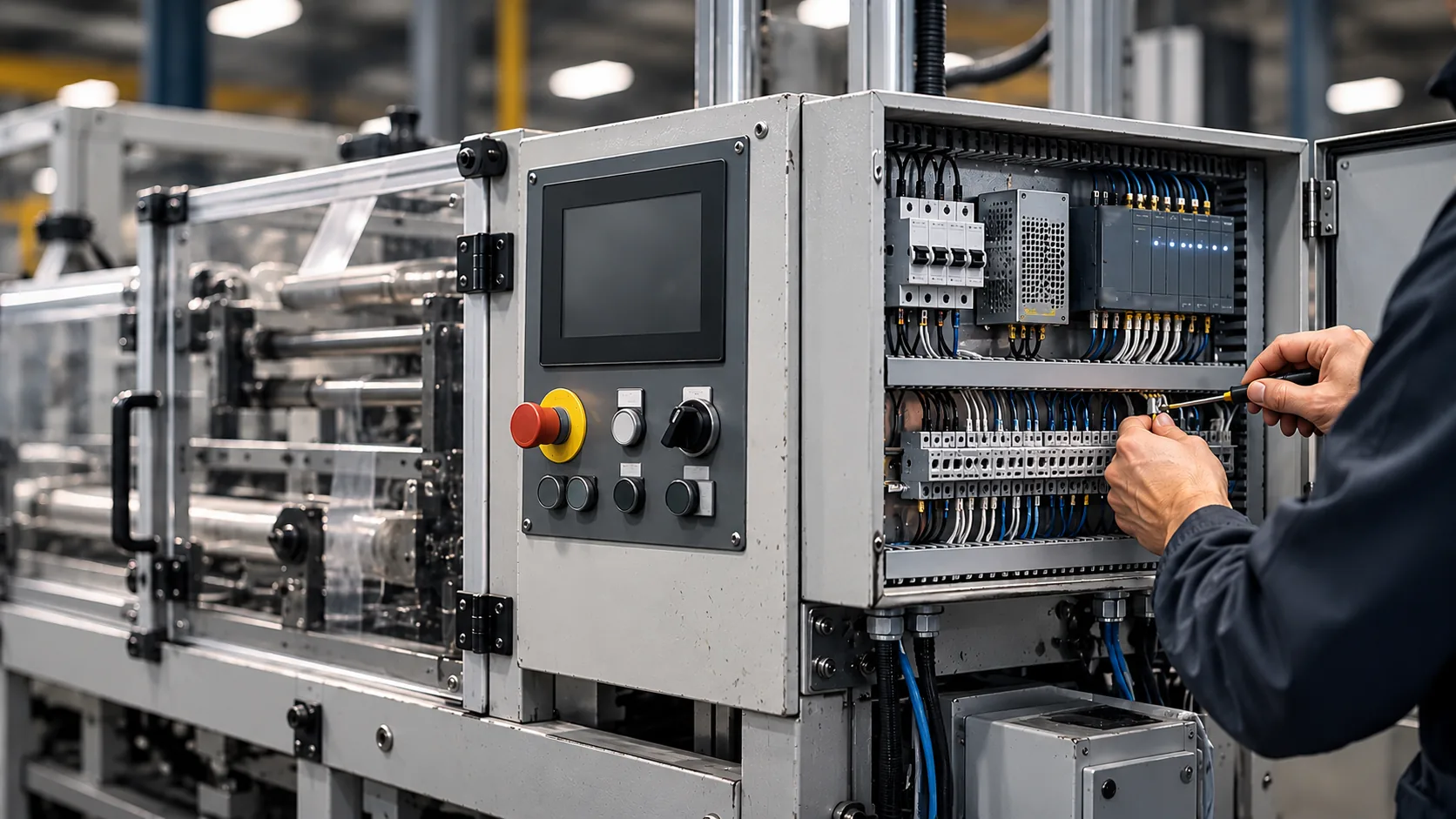
Technician wiring a PLC, a power supply and circuit breakers in an electrical enclosure added to the side of a packaging machine from the 2000s
AI-generated illustration: retrofit intervention, adding an automation enclosure to an existing machine.

Frequently asked questions about retrofit

What is a digital retrofit?

It is the modernisation of an existing machine (sensors, control, communication, software) so that it fits a modern information system, without replacing the machine itself.

My machine is old or its manufacturer no longer exists: is it possible?

Often yes, because a retrofit relies on what can be observed and measured on the machine, not on the manufacturer's support. Only a visit or an audit can confirm it machine by machine.

How much does a retrofit cost?

It depends on the machine and the goal: ShoWise only does custom work and therefore publishes no standard price. The gap with a replacement can be large, but it is only priced after a visit or an audit.

Does production have to stop?

The intervention is prepared to limit downtime: development and testing are done beforehand and offline as far as possible. Downtime is specified in the proposal.

What happens if my machine's control PC breaks down?

If the software can no longer be reinstalled or the interface no longer exists, the machine often has to be scrapped. That is why it is better to analyse and document the control side while the machine is still running, then modernise it offline.

Which systems can the machine communicate with?

MES, MOM, ERP, CMMS, supervision, databases or custom applications, using standard industrial protocols. The choice depends on the systems you already have.

A machine to modernise?

Describe your equipment and context to ShoWise.
A visit or an audit will tell whether a retrofit makes sense, and at what cost.

Assess my machine